

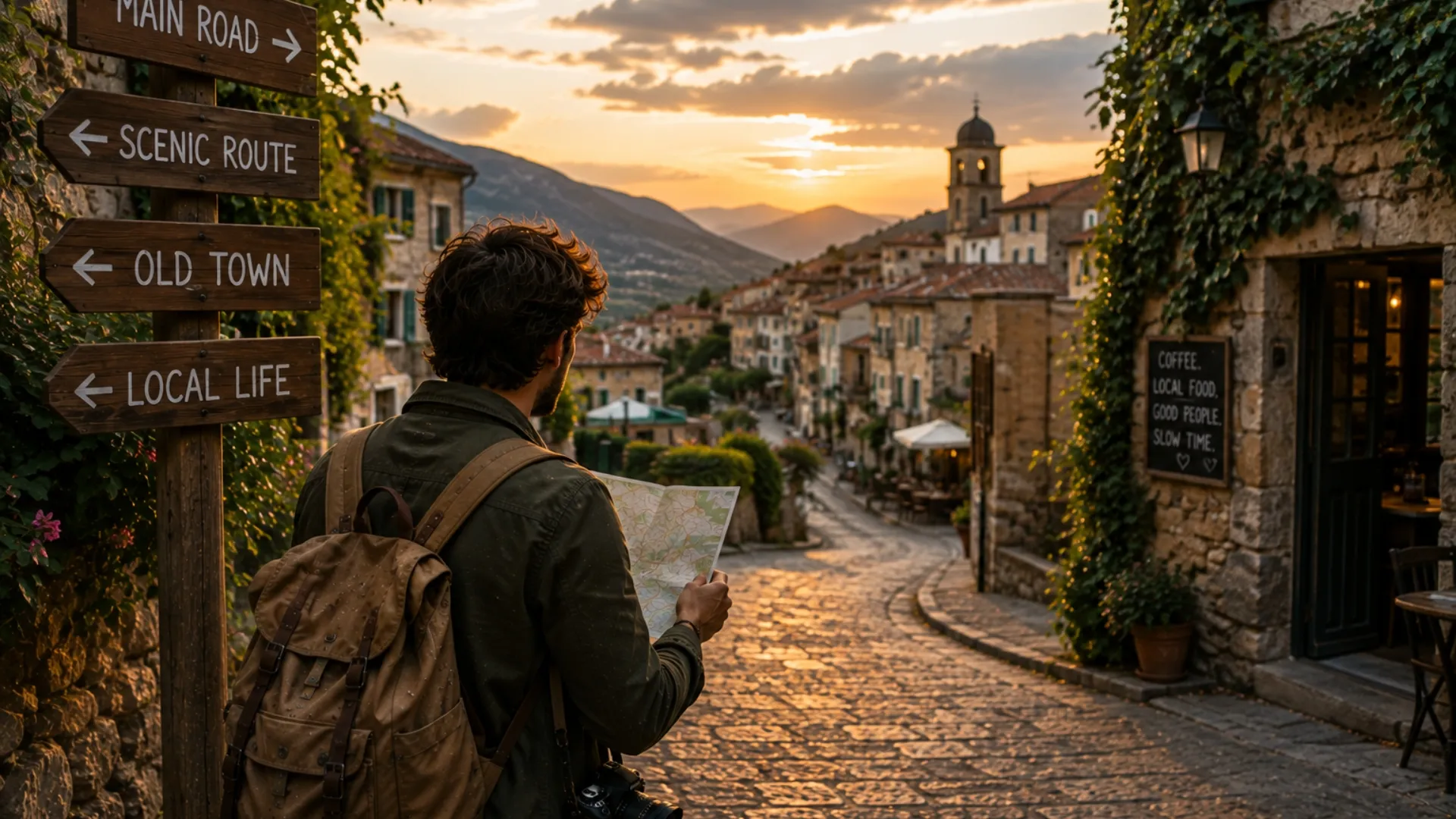
Some of my favorite travel memories began with something going wrong.
A missed turn.
A road I wasn’t supposed to take.
A street that looked more interesting than the one on my map.
A train station where I wasn’t completely sure I was standing on the right platform.
At the time, these moments didn’t always feel like adventures.
Sometimes they felt like mistakes.
But looking back, I realize that getting a little lost has often taken me closer to the places and experiences I would never have found by following the perfect itinerary.
I’ve learned that getting lost while traveling isn’t always something to avoid.
Sometimes, it’s an invitation to explore.
The Problem With Knowing Exactly Where You’re Going
Modern travel makes it incredibly easy to know where you are every second.
Your phone tells you which street to take.
It tells you how long the journey will take.
It tells you where to turn.
It can even tell you which restaurants are nearby.
That’s incredibly useful.
I use maps all the time.
But there are moments when knowing exactly where you’re going removes some of the mystery from travel.
When every turn is predetermined, there’s less opportunity for discovery.
I’ve started deliberately leaving some parts of my journey open.
Not completely unplanned.
Just flexible enough that curiosity can take over.
A Wrong Turn Can Become a New Route
I remember plenty of occasions when I’ve taken a wrong road and initially thought I’d wasted time.
Then something catches my attention.
A landscape.
An old building.
A small village.
A viewpoint.
A roadside café.
Suddenly, the mistake doesn’t seem so bad.
Instead of turning around immediately, I explore.
Sometimes the detour lasts ten minutes.
Sometimes it changes the entire day.
That’s one of the reasons I love road trips.
The road gives you choices.
You can take the fastest route.
Or you can take the interesting one.
I’ve learned to choose the interesting one when I have the time.
Getting Lost Makes You Pay Attention
When you know exactly where you are, it’s easy to walk without really looking.
You’re following the blue line on the map.
Turn left.
Continue straight.
Turn right.
Destination reached.
When you’re uncertain, you become more observant.
You start looking for landmarks.
You notice buildings.
You pay attention to street names.
You watch how people move around you.
You begin looking for clues.
That heightened awareness can make a destination feel much more alive.
As a photographer, I’ve found this especially valuable.
When I’m not rushing toward a specific location, I’m much more likely to notice photographs happening around me.
The Best Photographs Aren’t Always Planned
Some of my favorite travel photographs have come from places I never intended to visit.
I might be looking for one location and discover another.
The light might be perfect on a street I hadn’t even heard of.
A person might walk into the frame at exactly the right moment.
A storm might change the landscape.
A road might lead to an unexpected viewpoint.
Those photographs feel different from the ones I planned.
They carry a little more of the story with them.
When I look at them later, I don’t just remember the image.
I remember how I found it.
Follow the Interesting Street
When I’m exploring a city, I sometimes give myself a simple rule:
If a street looks interesting, follow it.
It might lead nowhere.
That’s okay.
It might lead to a beautiful neighborhood.
Even better.
The point isn’t always to find something spectacular.
Sometimes it’s enough to see how a city changes as you move away from its most visited areas.
You notice quieter streets.
Local shops.
Residential buildings.
Small parks.
People going about their everyday routines.
This is often where a destination starts feeling real.
Ask Instead of Immediately Checking the Map
There’s another way to recover from being lost.
Talk to someone.
I’ve asked locals for directions more times than I can remember.
Sometimes the answer gets me exactly where I need to go.
Sometimes it comes with an unexpected recommendation.
“You’re going there? You should also see…”
Those conversations can lead to places I would never have discovered through an app.
And even when I’m simply asking for directions, there’s something valuable about interacting with someone who actually lives there.
Travel becomes more human.
There Is a Difference Between Lost and Unsafe
Of course, there’s an important distinction.
Getting lost can be fun.
Being genuinely unsafe is not.
I don’t believe in taking unnecessary risks just to create a travel story.
If an area feels unsafe, conditions are changing, or I don’t have enough information, I’ll turn around.
I also make sure I have the essentials when exploring unfamiliar places—especially in remote areas.
A little preparation gives you the freedom to be spontaneous without being careless.
Don’t Rush to Correct Every Mistake
This is probably the biggest lesson I’ve learned.
My first instinct when making a mistake used to be fixing it immediately.
Wrong road?
Turn around.
Wrong street?
Check the map.
Missed a stop?
Figure out the fastest alternative.
Now I sometimes pause.
I ask:
“What if I don’t correct this immediately?”
Maybe I should see where the road goes.
Maybe I should walk another block.
Maybe I should explore the neighborhood.
Maybe the mistake is more interesting than the original plan.
Not every wrong turn needs to be corrected.
Some need to be explored.
Leave Room for the Unexpected
This is why I believe so strongly in slow travel.
When your schedule is packed from morning until night, there’s no room for accidents.
Every unexpected event becomes a problem.
A delayed train ruins the itinerary.
A wrong turn makes you late.
A restaurant recommendation becomes inconvenient.
But when you have time, unexpected moments become opportunities.
You can stop.
You can wander.
You can change direction.
You can stay another hour.
That’s freedom.
Some of the Best Stories Begin With “I Wasn’t Supposed to Be There”
When I think about the stories I tell most often from my travels, many begin with some version of that sentence.
“I wasn’t supposed to take that road.”
“I wasn’t planning to stop there.”
“I didn’t even know that place existed.”
“I thought I’d taken the wrong train.”
Those stories are usually more interesting than the perfectly executed days.
Because they contain uncertainty.
And uncertainty creates space for discovery.
Getting Lost Has Changed How I Travel
I don’t intentionally lose myself in every destination.
I still use maps.
I still plan routes.
I still book accommodation.
I still make reservations when necessary.
But I no longer believe that a good trip requires me to know exactly what will happen.
I want some mystery.
I want the possibility of finding something that wasn’t in the guidebook.
I want to leave enough room for the road to surprise me.
Because travel isn’t always about reaching the place you originally planned to visit.
Sometimes it’s about discovering the place you didn’t know you were looking for.
The next time you take a wrong turn, don’t immediately panic.
Look around.
Take a breath.
See what’s ahead.
Maybe turn around if you need to.
But if you have the time and the situation is safe, consider following the road a little farther.
You might be lost on the map, but you could be exactly where your best travel story begins.