

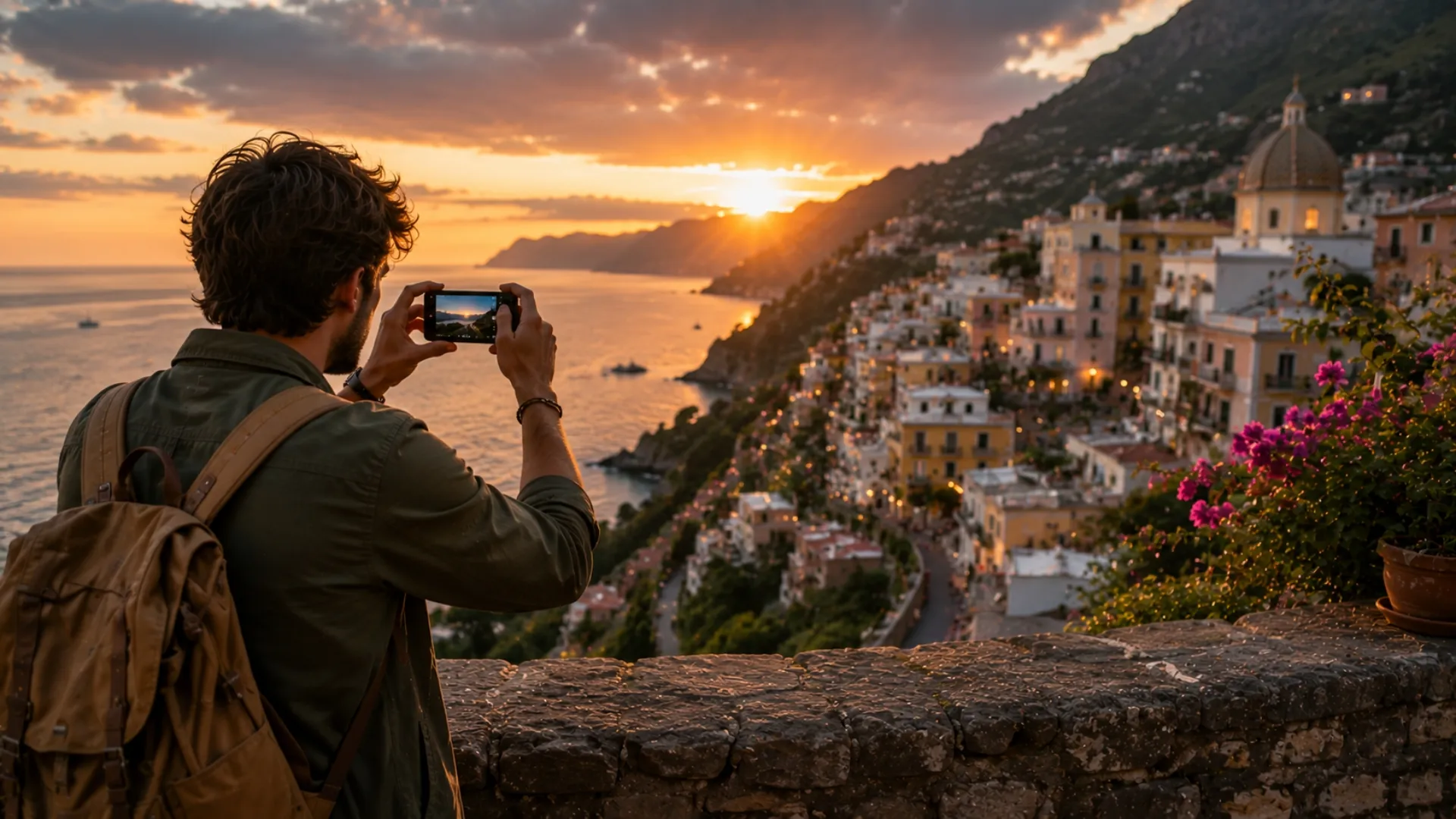
I’ve carried some expensive camera equipment around the world.
I’ve also taken photographs with a simple camera that happened to be with me when something unexpected happened.
And I’ve learned an important lesson:
Better travel photography isn’t necessarily about having better equipment.
A powerful camera can give you more options, but it can’t decide where to stand, when to press the shutter, or what makes a moment worth remembering.
Some of my favorite travel photographs came from situations where I had very little equipment and simply happened to be paying attention.
If you want to take better travel photos, start with the things that don’t cost anything.
Learn to See Before You Photograph
The biggest improvement you can make to your photography doesn’t require buying anything.
Slow down and look.
Before taking out your camera, ask yourself what actually caught your attention.
Was it the light?
The colors?
The person?
The landscape?
The architecture?
The atmosphere?
Once you understand what attracted you to the scene, you can start thinking about how to photograph it.
A camera records what you point it at.
Your job is to decide what deserves to be photographed.
Pay Attention to Light
Good light can transform an ordinary scene.
You don’t need expensive equipment to take advantage of it.
Early morning light can create soft, gentle shadows.
Late afternoon can produce warmer tones.
Overcast skies can create even lighting and bring out subtle details.
Even harsh midday sunlight can work if you use strong shadows and contrast deliberately.
Instead of asking whether the camera is good enough, ask:
Is the light helping the photograph?
That question will take you much further.
Move Your Feet
One of the easiest photography improvements is also one of the most overlooked.
Move.
Don’t take every photograph from standing height in exactly the same position.
Walk closer.
Step backward.
Move left.
Move right.
Get lower.
Find a higher viewpoint.
Change the angle.
A few feet can completely change the composition.
When I’m photographing a new place, I often walk around a subject before taking the final photograph.
The first position is rarely the only possibility.
Look for Interesting Foregrounds
Travel landscapes can sometimes feel flat in photographs.
One way to create more depth is to include something in the foreground.
It could be:
- rocks
- flowers
- architecture
- a road
- a doorway
- a fence
- a person
- reflections
These elements can help guide the viewer into the image.
You don’t need sophisticated equipment.
You simply need to notice what’s close to you.
Photograph People Naturally
People can give a travel photograph a sense of scale and story.
But don’t feel that every photograph needs a posed portrait.
Some of my favorite images happen naturally.
Someone walking through a street.
A vendor preparing food.
A cyclist passing an old building.
A person standing beside a mountain landscape.
These moments can feel more authentic because they aren’t staged.
Always be respectful when photographing people, particularly in culturally sensitive situations.
When appropriate, ask permission.
Don’t Photograph Only the Famous Landmark
A famous attraction is an obvious subject.
But ask yourself what surrounds it.
What does the street look like?
Who spends time there?
What happens early in the morning?
What’s behind the building?
What happens after the tourists leave?
A destination is more than its most photographed landmark.
When I build a collection of travel photographs, I want a mixture of landscapes, architecture, people, details, and everyday moments.
Together, those images tell a much better story.
Try Different Perspectives
You can make a familiar subject look completely different simply by changing your perspective.
Photograph from ground level.
Look upward.
Use a doorway as a frame.
Photograph through a window.
Use reflections in water or glass.
Find a natural frame around your subject.
Look for leading lines such as roads, walls, bridges, or paths.
These techniques don’t require expensive equipment.
They require observation.
Use Your Phone More Intentionally
A smartphone can be an excellent travel camera.
It’s small.
It’s always available.
And because you’re not carrying a large camera, people often behave more naturally around you.
The important thing is to avoid relying entirely on automatic composition.
Clean the lens.
Look at the light.
Tap to focus.
Move closer.
Try different angles.
Don’t zoom unnecessarily if it reduces image quality.
And most importantly, take your time.
A smartphone doesn’t prevent you from making a thoughtful photograph.
Wait for the Moment
Sometimes everything in a scene is right except one thing.
The person isn’t in the right position.
The clouds haven’t moved.
The light isn’t quite there.
The street is too crowded.
Instead of taking the photograph immediately, wait.
A few seconds can change everything.
Someone might walk into the frame.
The sun might appear between buildings.
A cyclist might pass through the light.
A cloud might create a dramatic shadow.
Photography often rewards patience.
Tell a Story, Not Just a Pretty Picture
This is perhaps the biggest difference between a technically good photograph and a memorable one.
Ask yourself:
What does this photograph say about the place?
A beautiful landscape is nice.
But perhaps a photograph of a person walking through that landscape tells a stronger story.
A perfect building photograph is useful.
But perhaps a photograph showing how people interact with that building says more.
When you travel, don’t only photograph what looks beautiful.
Photograph what feels meaningful.
Don’t Let Gear Become an Excuse
It’s easy to believe that the next lens, camera, tripod, or accessory will finally make your photography better.
Sometimes new equipment is genuinely useful.
But equipment should solve a problem.
It shouldn’t become the reason you postpone creating.
I’ve learned to get comfortable with the equipment I already have.
Know its strengths.
Understand its limitations.
Then concentrate on seeing.
The best camera is often the one you actually have with you when something happens.
The Best Travel Photos Come From Being Present
Travel photography isn’t really about collecting perfect images.
It’s about noticing moments.
The morning light on an unfamiliar street.
A conversation in a market.
A road disappearing into the mountains.
A stranger walking through a patch of sunlight.
Rain beginning to fall over a city.
A quiet landscape after everyone else has gone.
You don’t need an expensive camera to see those things.
You need curiosity.
You need patience.
And sometimes, you simply need to stop walking and look.
The equipment can help you capture the moment.
But it is your attention that finds it.

