

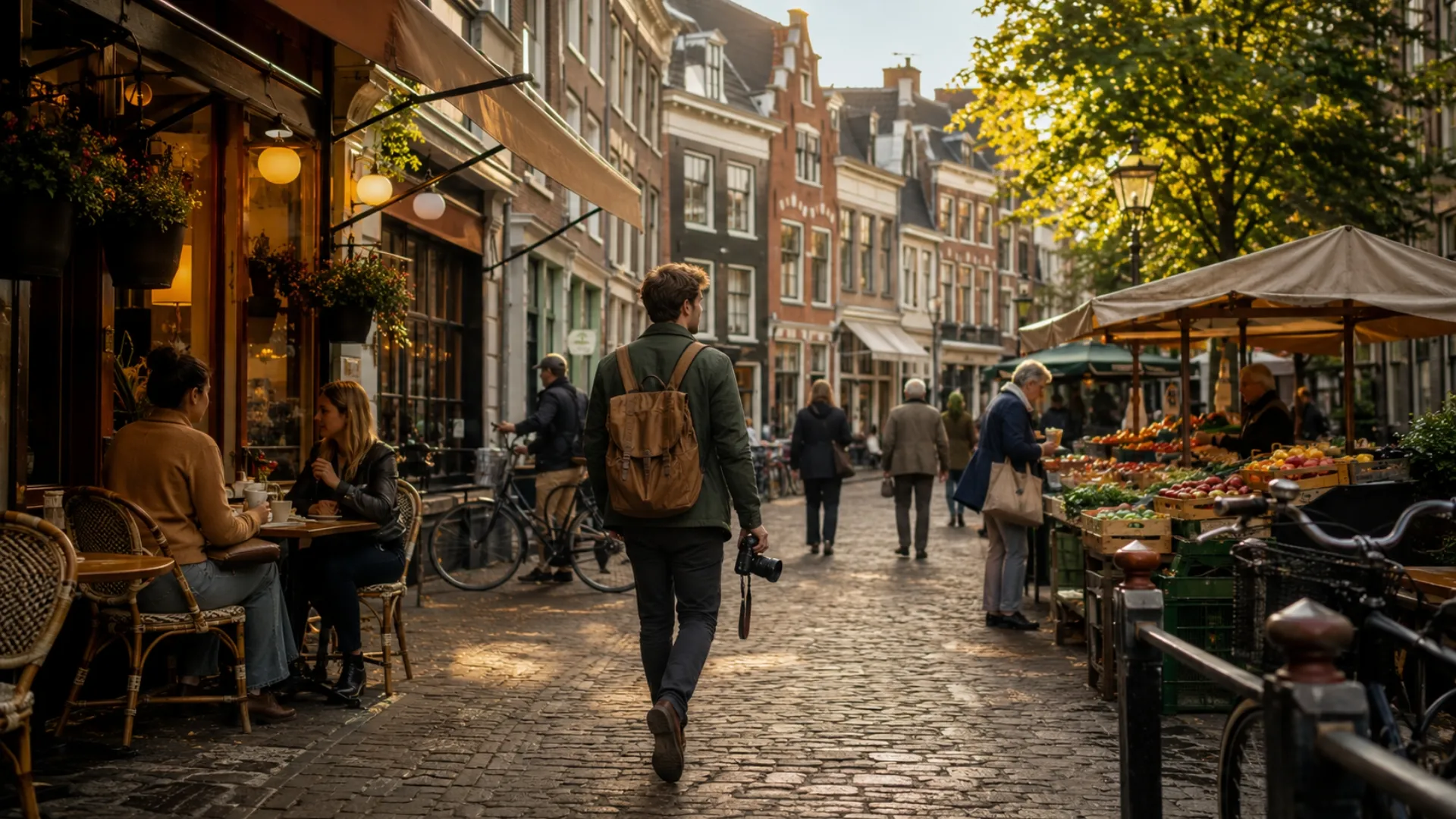
There is nothing wrong with being a tourist.
I’ve been one plenty of times.
I’ve stood in front of famous landmarks, taken the expected photographs, followed maps to popular attractions, and waited in lines with everyone else.
Those places are popular for a reason.
But over the years, I’ve discovered that some of my favorite travel memories happen after I leave the obvious tourist trail.
A city begins to feel completely different when you stop asking, “What should I see?” and start asking, “How do people live here?”
If you want to experience a new city like a local, you don’t need to avoid every famous attraction. You simply need to make room for the everyday side of the destination.
Start With the Neighborhood
When I arrive in a new city, one of the first things I like to do is walk around the neighborhood where I’m staying.
I don’t immediately search for attractions.
I look at the streets.
Where do people buy coffee?
Where are the small grocery stores?
Where do residents sit outside?
Which streets are busy in the morning?
Which ones become lively in the evening?
These observations tell you things a guidebook often can’t.
You begin to understand the rhythm of the neighborhood.
Walk Instead of Always Taking a Taxi
Public transportation is useful.
Taxis are convenient.
But walking gives you something neither can provide: time to notice the details.
You can stop whenever something catches your attention.
A small bakery.
An old building.
A street musician.
A local market.
A courtyard hidden behind a doorway.
You also get a better sense of how different parts of the city connect.
Sometimes I’ll deliberately walk without choosing the most direct route.
The slower route is often the more interesting one.
Eat Where Locals Eat
Food is one of the easiest ways to connect with a destination.
That doesn’t mean every meal needs to happen at a famous restaurant.
Try neighborhood cafés.
Visit local markets.
Look for restaurants filled with residents rather than tourists.
Ask someone where they would go for a casual meal.
And don’t be afraid to try something you can’t pronounce.
Some of my favorite travel meals have been completely unplanned.
They weren’t necessarily expensive or sophisticated.
They were memorable because they felt connected to the place.
Visit a Market
If a city has a local market, I almost always try to visit.
Markets show you everyday life in a way major attractions often can’t.
You see what people eat.
What they buy.
How they interact.
What products are produced locally.
You hear conversations, smell food cooking, and see routines that have nothing to do with sightseeing.
For a travel photographer, markets are also fantastic places for storytelling.
Learn a Few Local Words
You don’t need to become fluent.
Even learning a handful of basic words can change your interactions.
“Hello.”
“Thank you.”
“Please.”
“Excuse me.”
A little effort shows respect.
More importantly, it can make conversations feel warmer.
People generally appreciate travelers who make an attempt to communicate in the local language, even when the pronunciation isn’t perfect.
And yes, I’ve made plenty of pronunciation mistakes myself.
That’s part of learning.
Ask Locals for Recommendations
One of my favorite travel questions is:
“Where would you take a friend who was visiting for the first time?”
It’s better than simply asking for the top tourist attraction.
You might discover a quiet park, a family-run restaurant, a neighborhood viewpoint, or a place that isn’t in your guidebook.
Not every recommendation will work for you.
That’s okay.
The conversation itself can lead somewhere unexpected.
Don’t Photograph Everything Immediately
As a travel photographer, this is something I’ve had to learn.
When I first arrive somewhere beautiful, my instinct is to take photographs immediately.
But sometimes it’s better to spend the first hour simply looking.
Watch how people move through the space.
Notice where the light falls.
Find out which streets become busy.
Observe what makes the neighborhood feel different.
Then pick up the camera.
You’ll often photograph better because you understand the place a little more.
Spend Time Doing Ordinary Things
This might be the biggest difference between sightseeing and experiencing a city.
Go grocery shopping.
Sit in a café.
Take a local train.
Visit a bookstore.
Walk through a residential area.
Spend an afternoon in a park.
These activities might not sound exciting when you’re planning a trip.
But they can become some of your strongest memories.
Travel doesn’t always need to be spectacular.
Sometimes ordinary life is exactly what you came to see.
Don’t Try to Become a Local Overnight
There is also a balance.
You are still a visitor.
You don’t need to pretend otherwise.
The goal isn’t to imitate local people or claim that you’ve suddenly understood an entire culture after a few days.
It’s simply to approach the destination with curiosity and respect.
Observe.
Listen.
Ask questions.
Be open to doing things differently.
That’s enough.
The Best Way to Know a City Is to Slow Down
You can’t understand a city in a weekend.
You probably can’t understand it in a month either.
But you can begin to notice its personality.
And that happens when you slow down.
Visit the famous landmark, but then walk beyond it.
Eat the local food.
Talk to people.
Use public transportation.
Explore neighborhoods.
Put the camera away occasionally.
Give yourself permission to have an ordinary afternoon.
Because the best way to experience a new city like a local isn’t to avoid being a tourist.
It’s to become curious enough to look beyond the tourist version of the city.
That’s where the real stories usually begin.

4 Comments
William Clark
Morbi eget ligula gravida, pulvinar magna eget, eleifend. Proin massa tortor, are sit amet commodo et, eleifend vel odio. Integer porta orci ornare metus.
Shery Turner
Proin massa tortor, are sit amet commodo et, eleifend vel odio. Integer porta orci ornare metus. egestas.
Set Mitchell
Lorem ipsum dolor sit amet, consetetur sadipscing elitr.ased diam nonumy eirmod tempor invidunt ut labore et dolore magna aliquyam erat, sed diam
Dorothy Finley
Morbi eget ligula gravida, pulvinar magna eget, eleifend. Proin massa tortor, are sit amet commodo et, eleifend vel odio. Integer porta orci ornare metus.
Comments are Closed.